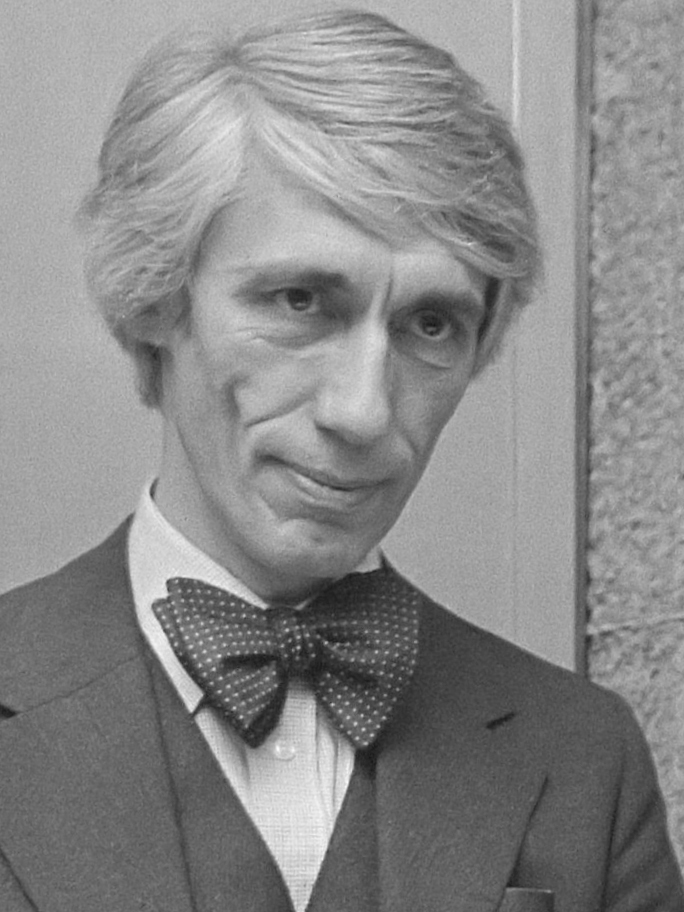
Shigeo Fukuda
- Graphic Design
Contents 8 sections +
Contents
Overview
The Getty Research Institute's Union List of Artist Names (ULAN) records Shigeo Fukuda as a person under identifier 500202745 and lists him among artists associated with the Museum of Modern Art, New York, a relationship whose recorded date range begins in 2000.1 Getty identifies posters on social concerns among his work and names the 1970 World's Fair in Osaka as an event for which he produced poster work.1
At a glanceSourced facts

At a glance
Shigeo Fukuda
Key facts
A secondary profile describes Shigeo Fukuda as a Japanese graphic artist, poster designer and sculptor who created optical illusions, and gives his life dates as 1932–2009.2,3 The same profile reports that he held solo exhibitions in New York, Toyama (Japan), Warsaw (Poland) and Lahti (Finland), without giving dates.2 According to Impossible world, in 1986 he received Honorary Royal Designer for Industry from the Royal Society of Arts in London.2
An obituary notice reports that Fukuda died in Tokyo on 11 January 2009 at the age of 76, as the result of a subarachnoid hemorrhage.3 The same notice states that he served as vice president of the Icograda executive board from 1993 to 1995.3 A commercial gallery listing identifies a poster project titled Nouveau Salon des cent, Hommage a Toulouse-Lautrec, initiated by the Toulouse-Lautrec Museum Partners' Club and produced in cooperation with the Toulouse-Lautrec Museum of Albi.4
That listing records that Fukuda received the Grand Prix at the Helsinki International Poster Biennale and the Grand Prix Savignac at the Paris International Poster Exhibition.4 It further states that in 1996 he was selected in an international invitation competition for the official pictograms and signs of Expo '98 in Lisbon, and that in 1997 the National Museum of Modern Art, Tokyo presented his solo exhibition titled 'An artist of visual wit'.4
Viewpoints and evidence
An Icograda-related obituary describes Fukuda as a deeply respected member of that community.3 A Korean design study of his posters describes their simplified design as successful, presenting his work as an example of simple design within a trend toward simplification.5 A Chinese design study describes Fukuda as a master of design in both Japan and internationally.6
The same study holds that his figure transformations and upside-down images link a dreamlike illusion directly to the poster's real-world theme.6 A description of his collected work states that his visual wit and optical illusions communicate across many cultures.2,6,7 The same catalogue description regards him as one of the finest and most creative poster artists in the world.7
Open questions
- The sources available here do not provide dates for the solo exhibitions in New York, Toyama, Warsaw and Lahti, nor the year of the Helsinki International Poster Biennale Grand Prix or the Paris Grand Prix Savignac.
- No evidence in the ledger covers Fukuda's education, early career, or family life, so these are not addressed.
The cited sources do not settle these questions. They remain open, not guessed.
Sources
- 1ULAN Full Record Display (Getty Research)getty.edu · Universities & libraries · Tier B
- 2Shigeo Fukuda - Impossible sculptures - Impossible worldImpossible world · Other · Tier C
- 3Shigeo Fukuda Passes Away at 76dexigner.com · Other · Tier C
- 4Nouveau Salon des cent, Hommage a Toulouse-Lautrec.Yaneff.com · Other · Tier C
- 5Expression Style of Shigeo Fukuda's Poster한국디지털디자인협의회 conference (2007) · Research · Tier C
- 6On Fukuda Shigeo' Design ConceptJournal of Dalian University (2008) · Research · Tier C
- 7Shigeo Fukuda masterworksMedical Entomology and Zoology (2005) · Research · Tier C
Fact-checked by multiple models via Vercel AI Gateway
Image plates


Lifeline
1986–2009 · scroll to travel1986
1996
2000
2009
4 dated events from this entry and its sources · Elapsed: years since 1986, the first dated event