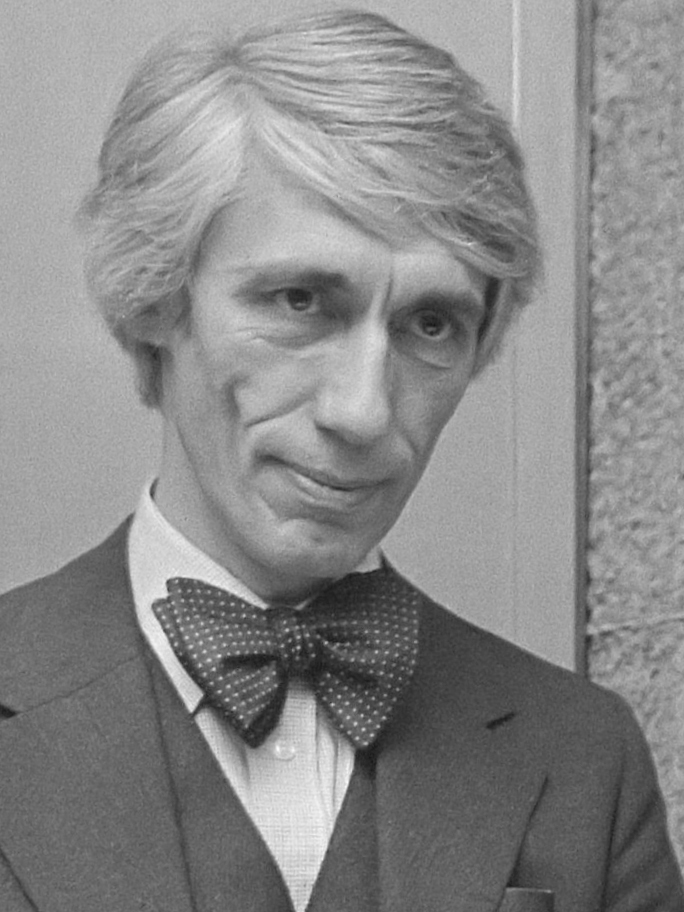
Josef Müller-Brockmann
- Graphic Design
Contents 7 sections +
Contents
Overview
Getty ULAN provides semantic web representations (JSON, JSONLD, RDF, N3/Turtle, N-Triples) for Müller-Brockmann's record.1 Reference listings for him include Bénézit (2006), Grove Art Online, and Library of Congress authority n 50004563.1 Müller-Brockmann is recorded in the Getty Union List of Artist Names with ULAN ID 500125350.1
Getty’s Union List of Artist Names records him as a person under identifier 500125350.1 According to ULAN Full Record Display (Getty Research), his posters and design work are held in museum collections, including the Museum of Modern Art, New York, and the Getty Research Institute holds his papers via the Harald Szeemann collection reference, a point on which the panel's sources or readings disagree.1
At a glanceSourced facts

At a glance
Key facts
Müller-Brockmann is associated with the Museum of Modern Art New York artists records from 2000 onward.1 ULAN links his name to MoMA artist records and to the Harald Szeemann papers finding aid.1 Müller-Brockmann's papers are held in the Harald Szeemann papers at the Getty Research Institute Special Collections.1
Müller-Brockmann's name appears in the Bénézit Dictionary of Artists, Grove Art Online, and Library of Congress Authorities.1 According to Eye Magazine, “Müller-Brockmann was founder and, from 1958 to 1965, co-editor of the trilingual journal Neue Grafik (New Graphic Design) which spread the principles of Swiss Design internationally”.2 According to hls-dhs-dss.ch, Josef Müller-Brockmann was born on 9 May 1914 in Rapperswil, St. Gallen.3
According to hls-dhs-dss.ch, Müller-Brockmann died on 30 August 1996 in Unterengstringen, Switzerland.3 According to hls-dhs-dss.ch, he died on 30 August 1996 in Unterengstringen.3 According to hls-dhs-dss.ch, he was without religious confession and a citizen of Eschenbach (St. Gallen) and Zurich.3
According to hls-dhs-dss.ch, he married Verena Brockmann in 1943.3 According to hls-dhs-dss.ch, Müller-Brockmann was married to Verena Brockmann in 1943.3 According to hls-dhs-dss.ch, he married Shizuko Yoshikawa in 1967.3
According to hls-dhs-dss.ch, Müller-Brockmann's second wife, Shizuko Yoshikawa, was the daughter of a Japanese naval engineer and merchant from Omuta.3 According to hls-dhs-dss.ch, from 1932 he took courses at Zurich’s art school, university, and ETH, including with Carl Gustav Jung, after an interrupted graphic apprenticeship.3 According to hls-dhs-dss.ch, he worked as an independent graphic designer and illustrator from 1934.3 According to hls-dhs-dss.ch, Müller-Brockmann was a graphic designer and illustrator working independently from 1934.3
Research
According to a paper in a 2020 paper, he is widely known for his poster designs, including the road-safety poster 'schutzt das Kind!' (protect the child).4 His Zurich-based practice served both corporate and nonprofit clients.4 He taught at Zurich's Kunstgewerbeschule (school of applied arts).4
Müller-Brockmann initiated Neue Grafik and served on its editorial group with other designers.2,5 Neue Grafik was published in Zurich from 1958 to 1965.5 The journal was his initiative and was led by an editorial group that included him and fellow designers.5 According to a 2000 paper in L. Müller eBooks, he is the subject of the monograph 'Josef Müller-Brockmann: Pioneer of Swiss Graphic Design'.6
Viewpoints and evidence
According to Josef Müller-Brockmann, he advised young people to view what they encounter critically and to remain self-critical.2 According to Eye magazine, Neue Grafik spread the principles of Swiss Design internationally.2 According to Josef Müller-Brockmann, Müller-Brockmann described unconscious experience as contributing to his design process.2
Müller-Brockmann said self-criticism led him to reconsider his earlier illustrative work despite its apparent success.2 He said apparent success in illustration led him to conclude he had no essential artistic talent beyond the ordinary.2 He said he had to teach himself to distinguish creative work from imitative or merely calculating work.2
Müller-Brockmann said he conceived a periodical devoted to rational, constructive graphic design in 1955.2 According to Josef Müller-Brockmann, Müller-Brockmann described the periodical as a response to advertising he considered excessively irrational and pseudo-artistic.2 According to a paper in a 2020 paper, “Josef-Müller-Brockmann (1914–96) was one of a group of graphic designers who defined a “Swiss” or “International Typographic Style” after World War II”.4
According to a paper in a 2020 paper, a scholarly article frames Swiss Design as having a mythology, using his child-safety poster 'schützt das Kind!' as a case study.4 According to a paper in a 2020 paper, a scholarly study examines Müller-Brockmann’s work in relation to the mythology surrounding Swiss Design.4 According to a paper in a 2020 paper, scholarship describes a 'mythology' around Swiss Design, suggesting his canonical status is partly a constructed narrative rather than pure fact.4
According to Author of 'Josef Müller-Brockmann: pioneer of Swiss graphic design', a catalogue description places his sudden turn to constructive graphic design in the early 1950s, when he was almost 40.6 According to a 2000 paper in L. Müller eBooks, Müller-Brockmann's appearance in constructive graphic design in the early 1950s, at almost age 40, is described as impassioned and sudden.2,6 The same description says that in the 1930s his path and Swiss graphic design were still separate.6
Sources
- 1ULAN Full Record Display (Getty Research)getty.edu · Universities & libraries · Tier B
- 2Eye Magazine | Feature | Reputations: Josef Müller-BrockmannEye Magazine · Other · Tier C
- 3Müller-Brockmann, Josefhls-dhs-dss.ch · Other · Tier C
- 4Josef Müller-Brockmann: “schutzt das Kind!” and the Mythology of Swiss Designa 2020 paper · Research · Tier A
- 5Neue Grafik (New Graphic Design) (1958–65)The Bloomsbury Encyclopedia of Design (2016) · Research · Tier A
- 6Josef Müller-Brockmann : pioneer of Swiss graphic designL. Müller eBooks (2000) · Research · Tier C
Fact-checked by multiple models via Vercel AI Gateway
Image plates


Lifeline
1914–1996 · scroll to travel1914
1943
1943
1955
Josef Müller-Brockmann. beethoven poster(1955)Wikimedia Commons ↗
Josef Müller-Brockmann. beethoven poster(1955)JOSEPH MÜLLER-BROCKMANN · CC BY-SA 4.0 · Wikimedia Commons 1957
Poster for Juni-Festwochen Zürich (1957) designed by Josef Müller-BrockmannWikimedia Commons ↗
Poster for Juni-Festwochen Zürich (1957) designed by Josef Müller-BrockmannJosef Müller-Brockmann · Public domain · Wikimedia Commons 1959
Musica Viva poster design (1959) by Josef Müller-Brockmann.Wikimedia Commons ↗
Musica Viva poster design (1959) by Josef Müller-Brockmann.Josef Müller-Brockmann · Public domain · Wikimedia Commons 1960
Offset lithograph poster for Der Film by Josef Müller-Brockmann, 1960Wikimedia Commons ↗
Offset lithograph poster for Der Film by Josef Müller-Brockmann, 1960Josef Müller-Brockmann · Public domain · Wikimedia Commons 1967
1975
Akari Catalogue by Josef Müller-Brockmann, interior layout (1975)Wikimedia Commons ↗
Akari Catalogue by Josef Müller-Brockmann, interior layout (1975)Simon Malz · CC BY-SA 2.0 · Wikimedia Commons 1975
Akari Catalogue by Josef Müller-Brockmann (1975)Wikimedia Commons ↗
Akari Catalogue by Josef Müller-Brockmann (1975)Simon Malz · CC BY-SA 2.0 · Wikimedia Commons 1981
Cover of the book “Grid systems – Raster systeme”, by Josef-Müller-Brockmann, published by Niggli in 1981.Wikimedia Commons ↗
Cover of the book “Grid systems – Raster systeme”, by Josef-Müller-Brockmann, published by Niggli in 1981.Josef Müller-Brockmann · Public domain · Wikimedia Commons 1996
1996


13 dated events from this entry and its sources · Age: years since birth in 1914