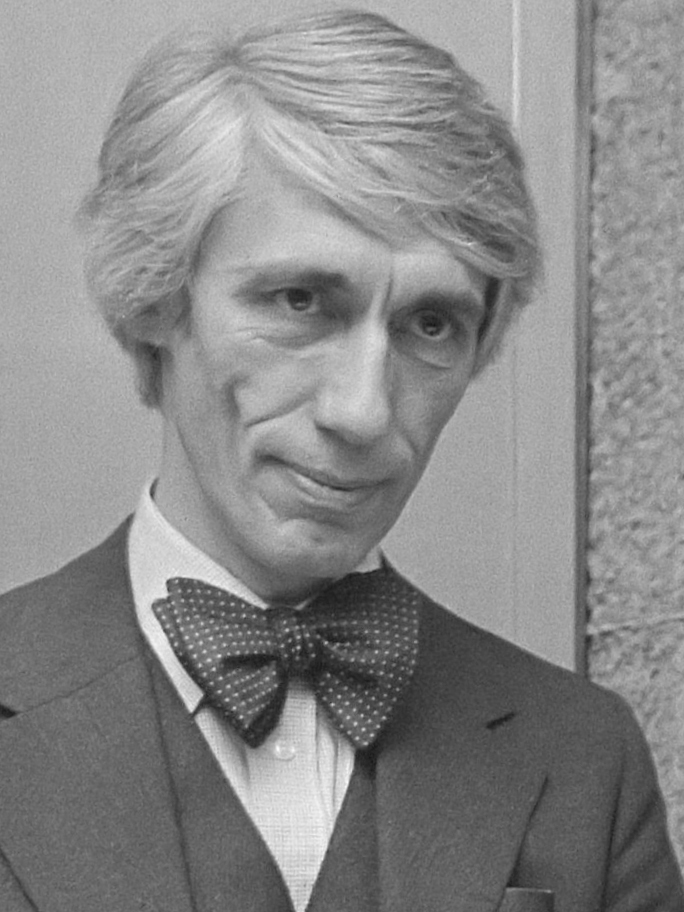
Michael Bierut
- Graphic Design
Contents 10 sections +
Contents
Overview
Michael Bierut is a graphic designer and partner at Pentagram. He was born in Cleveland, Ohio, in 1957, and graduated with highest honors from the University of Cincinnati’s design college in 1980.1,2,3
At a glanceSourced facts

At a glance
Early life and education
Bierut has said that he learned the name “graphic design” at age fifteen after finding a book by S. Neil Fujita in a school library, and later researched the subject at a public library in Ohio.1 He has described two early books, by Milton Glaser and Armin Hofmann, as seemingly opposed in approach.1
Career

According to Pentagram, Bierut’s first job after graduation was with Lella and Massimo Vignelli.1,2 He joined Pentagram’s New York office as a partner in 1990.1,4 Bierut has said he began at Pentagram with no clients or team and was 33 at the time.4
Pentagram describes him as a graphic designer for nearly fifty years.2 According to Pentagram, Bierut’s clients have included Mastercard, Slack, Verizon, Disney, the Brooklyn Academy of Music and MIT Media Lab.2 He designed the Mastercard logo, the “H” logo for Hillary Clinton’s 2016 presidential campaign, and building signage for The New York Times.4 Bierut has said he has taken part in meetings with The New York Times, a presidential candidate and a university laboratory despite not having those professional backgrounds.4
Recognition and collections
Bierut was elected to the Alliance Graphique Internationale in 1989, entered the Art Directors Club Hall of Fame in 2003, and received the AIGA Medal in 2006.2 His work is held in the collections of the Museum of Modern Art, the Metropolitan Museum of Art, the Cooper Hewitt, the Library of Congress, the San Francisco Museum of Modern Art and the Denver Art Museum.3,5 According to Eye on Design, Bierut served as president of the national board of directors for AIGA.5
The AIGA Design Archives contain more than 100 works by Bierut.5 AIGA Eye on Design described him as a “designer’s designer” and characterized his clientele as often including design organizations, museums and architects.5
Writing and publishing
According to Pentagram, he co-edited the five-volume Looking Closer series and co-founded Design Observer.2 According to Design Indaba, a book examining 35 of Bierut’s projects, including preparatory sketches, was published in September 2015.5,6
Design philosophy
Bierut has said that design audiences are becoming more sophisticated and that designers who underestimate public taste will be punished.5 He has also said the public will not tell designers how to change their minds.3 He has cited the Bulletin of the Atomic Scientists’ Doomsday Clock cover, designed by Martyl, as an example of a client trusting a designer without a detailed briefing.3
Bierut has said he found himself becoming more calculating and artificial in his work.4 He has said that he is not an MBA, but is married to one, and described himself as a quick study and a fairly good mimic.4 He has advised sharing a project’s central idea with a team and giving its members substantial responsibility, saying this can benefit their development as designers and thinkers.4
Later career
The Creative Factor reported that about 35 years after Bierut joined Pentagram, he again had no clients or team members; the cited profile excerpt does not explain the circumstances.4 The same profile stated that Pentagram had 24 partners.4
The thing that interests me the most
Sources
- 1Eye Magazine | Feature | Reputations: Michael BierutEye Magazine · Other · Tier C
- 2Michael BierutPentagram · Other · Tier C
- 3Michael Bierut - City AtlasCity Atlas · Other · Tier C
- 4Michael Bierut Reflects on His Storied Career (and He’s Not Done Yet!) — The Creative FactorThe Creative Factor · Other · Tier C
- 5Michael Bierut on Tough Design Assignments + What it’s Like to be Publicly ScrutinizedEye on Design · Other · Tier C
- 6From our archives: Michael Bierut on how to think like a designer | Design IndabaDesign Indaba · Other · Tier C
Fact-checked by multiple models via Vercel AI Gateway
Image plates

Lifeline
1957–2016 · scroll to travel1957
1989
1990
2007
Saks Fifth Avenue Logo Horizontal 2007Wikimedia Commons ↗
Saks Fifth Avenue Logo Horizontal 2007Saks, Inc. · Public domain · Wikimedia Commons 2015
2016
Mastercard logo used in the cards and by the company from July 14, 2016 to July 1, 2020.Wikimedia Commons ↗
Mastercard logo used in the cards and by the company from July 14, 2016 to July 1, 2020.Mastercard Inc. and Pentagram Design · Public domain · Wikimedia Commons


6 dated events from this entry and its sources · Age: years since birth in 1957